I met Amy Johnson at our Black Bear Physical Therapy tent at the end of the Table Rock Ultra.
As we talked, her story kept unfolding in amazing ways and I knew I wanted to share it.
Amy is an accomplished marathoner and ultrarunner, a working mother of four, and the kind of athlete whose story challenges some of the assumptions we make about what high-level training has to look like.
In the span of about a year, Amy went from running some of the best races of her life, to suffering a femoral head stress fracture and being unable to bear weight, to rebuilding her strength and eventually finishing the Umstead 100 in 17:41 and placing third female.
But the part of her story that stuck with me most wasn’t a race result.
It was the way running fits around the rest of her life: her kids, her work, her marriage, and the things she considers more important than running.
Her recovery also offers a powerful reminder that returning from injury isn’t only about getting back to running—it’s about restoring the capacity underneath it.
Amy was generous enough to share the story in her own words.
My Running Journey
I started running in my mid-twenties, after graduating from nursing school and suddenly having a lot more time on my hands.
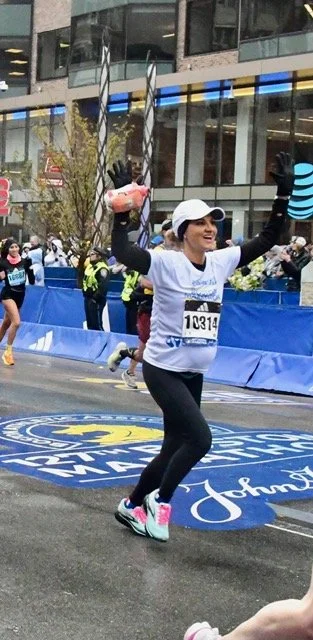
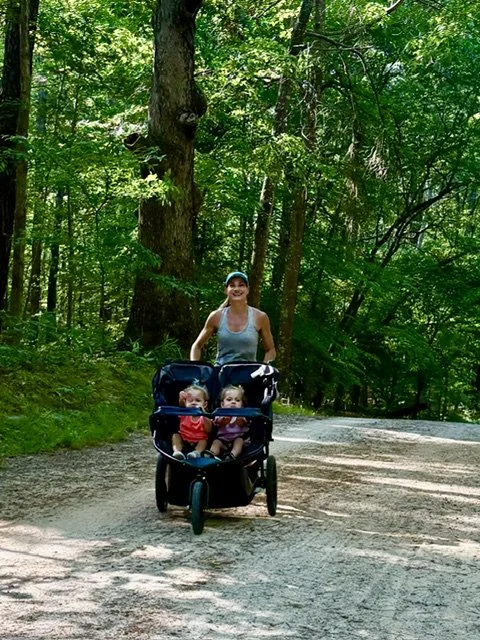
For the last six years or so, most of my running has consisted of stroller runs around my neighborhood, usually 3–10 miles at a time. First I ran with my older daughter, and then with my twins in a double stroller. Fun fact: I’ve run six Boston Marathons, and I was pregnant for two of them!
Stroller running must have helped me in some way because, to my surprise, I’ve actually had the most success with running after having kids. That includes everything from my fastest mile (5:34) to my longest distance (100 miles).
In 2024, after running but not really racing through most of my twin pregnancy and early postpartum period, I finally felt like I was back at it.
When the twins were 9 months old, I won first female at the Foot Levelers Blue Ridge Marathon, a very hilly course in Roanoke. They invited me back for the 2025 race and comped my entry.
In October 2024, I won first female at the Sky to Summit 50K trail race in North Georgia, which earned me a comped entry to the sold-out 2025 Georgia Death Race 74-mile race.
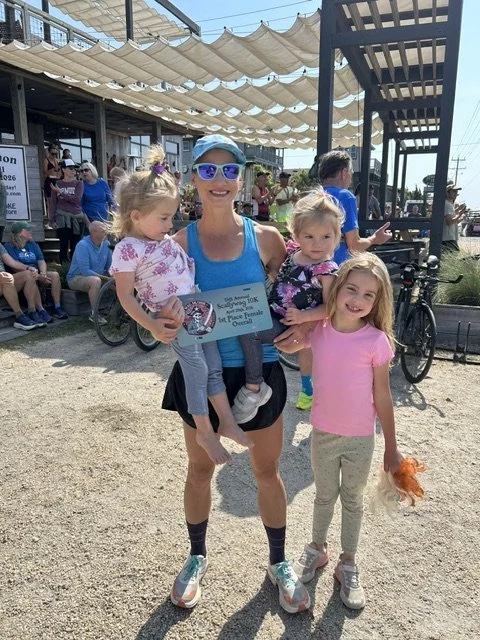
Then, in February 2025, I ran a marathon PR of 3:05 at the Wilmington Marathon. It’s a competitive race, so I didn’t podium, but I did win my first “masters” category award—which was pretty funny to accept while holding my 19-month-old twins!
At that point, everything was going great. I felt like I was on a roll!
When Things Went Wrong
I returned to the Blue Ridge Marathon in April 2025 and ran faster than I had the year before, finishing in 3:18. But immediately afterward, I noticed some pain in my left hip and had a bit of a limp.
Nine days later, I ran the Boston Marathon. I still had the limp, but I popped some ibuprofen, said a prayer, and hoped the endorphins would kick in…they did, but only lasted for 16 miles. I actually held a sub-3-hour marathon pace when the pain stopped me in my tracks. I could hardly lift my left leg and struggled with every step. I was leaning to the side and basically hobbled through the final 10 miles. It was painful, but I still thought it was just a severe muscle strain. I decided to make the best of it though. That last 10 miles, I soaked in the sights, cheering crowds and enjoyed the fun of the course—things I usually miss when I’m focused on racing.
After the one-hour car ride back, though, I could not bear weight. I made my husband go buy me crutches so I could get around our Airbnb and make it through the rest of the week-long trip we had planned. A week later, I had an MRI, which showed a left femoral head stress fracture.
Looking back, I hadn’t really considered that over the previous six years I had either been pregnant or breastfeeding, and that my bone density could potentially be affected by that. I asked my doctor for a DEXA scan, which came back at the lower end of the normal range.
The Hardest Part of Recovery
The next two months were nuts! The twins were enrolled in a brand-new school, but its construction and opening kept getting delayed. Fortunately, my work had already allowed me to work from home while caring for them until the school opened. That was a huge blessing, but working and momming at the same time was already difficult. Ha, ha! Let’s add non-weight-bearing and crutches to this silly game! Every day was a struggle as I tried to care for two toddlers while working. It reminded me a lot of the newborn days: you just survive. As long as everyone is fed and happy, the day is a success. Then you go to bed, hope you get some sleep, and wake up and do it all over again.
Ideally, I would have incorporated some non-weight-bearing exercise during those few months. I always had ideas in my head about things I could do, like floor exercises, but the reality was that it took me so long to accomplish even the simplest daily tasks that there just wasn’t time for “me.”
Building Back
Once I was able to bear weight again, the rebuild was gradual. I had lost a lot of lower-body strength, so I started going to the gym five or six days a week, focusing on rebuilding my legs and glutes and doing a lot of single-leg exercises.
My first run post-injury was in July, and it was tough. I intentionally ran no more than every other day to give myself plenty of time to recover—especially because I was still breastfeeding, still not sleeping through the night, and the twins were approaching age two.
I had to go back and look because it's a bit of a blur now, but once I got released to bear weight I still only walked for another 3 -4 weeks before I felt like I could attempt to run. I did however do a lot of indoor cycling - something I rarely do but it helped build back my lost glute strength. Then, I added in some elliptical and eventually running. July and August were gym sessions 5 - 6 days a week and I either did a 20 -40min stationary bike ride, elliptical or stair stepper in effort to get my cardio back and then did strength.
Luckily working for a university means summers are typically slower and I fortunately had a lot of flexibility in my schedule. Since I was caring for the twins 24/7 at this point, the 2 hours of YMCA childcare was all I had and I maxed that out! lol I think it's pretty safe to say that I was going to the gym at least 5 days a week during the summer, plus doing an afternoon stoller walk or run everyday for their nap time. I intentionally didn't run back to back days for awhile. On days that work is busy, my workouts are more like 45 minutes rather than 2 hours but I'm pretty consistent with it on the weekdays. Looks like I average about 4/5 runs a week as well.
The Role of Physical Therapy
I never did mention it before, but I found a great PT that worked with me. I started with the practice that my ortho doc referred me to. By the time I got in, I was already going to the gym on my own. In my eval, I said I wanted to be challenged and that my goal was to run a marathon in 4 months. It was a large clinic and I was seen by a different person every time, and they had me doing very basic exercises, which I felt like I had already advanced past. I switched to a PT that specialized in runners and she was amazing! I only had time to go every 2 weeks and she knew I was going to do my own workouts anyway but she would assess my strength progression, do a treadmill run analysis and give me feedback on my form. She also came to cheer for me at Umstead, which was awesome!
What “Training” Looks Like
Honestly, I feel a little silly even using the word “training.” I’ve never followed a structured training plan. I run by feel and make it up as I go along. I track my runs, but I don’t allow myself to care too much what the final mileage is at the end of the day, week, or month. I think if I obsessed over it too much, running wouldn’t be fun anymore—and my goal is to keep enjoying it. I never want running to become something I “have” to do. It’s something I “get” to do, and I feel incredibly blessed to be able to run. It sounds cliche but I do believe consistency has really been the key. On most days, getting a run or workout in is just as much part of my day as brushing my teeth.
For all of my kids, stroller runs were such a regular part of our routine that they actually relied on the run for nap time. Even on the occasional rest day, the stroller run was the only way the kids would sleep…so off we went! I’d average around 35 miles a week. Most of my runs naturally follow the same pattern: start easy and warm up, gradually pick up the pace, run around threshold pace for most of the run, and then, toward the end, pick it up for fun—usually kicking into high gear for the last mile or so.
And honestly, when 90% of your runs are done pushing a stroller and then you get to race without one…it feels like magic! I shocked myself with some of the paces I could hit in races when I was finally stroller-free.
I guess to clarify my runs - my watch will label most of my runs threshold based on my heart rate. When pushing the twins, my pace is certainly not my actual threshold pace but my heart rate might look like it is. The pace varies widely with the stroller - I can fly down the hills (not good for form) but I'm hitting max heart rate going up a hill at a 10min/mile pace. I rarely look too much into the stats. The way I feel tells me more than my watch can.
More recently though, I run alone. I tend to have some easy runs usually when I can get to some trails and have time, but more often than not I am squeezing a run into a busy day so I start slow and pick it up to get as many miles as I can into the time I have. Most road miles are probably at 7:30 - 8:30 pace and maybe a sub 7 or two at the end just to finish it off - but likely I am racing the clock for one of the following reasons: my husband leaving the house for work (morning runs), I have a meeting (lunch runs) or I'm trying to beat the bus dropping off my kiddo (afternoon runs.)
How Much Mileage?
As far as overall mileage, when I look back at the months preceding the 100 miler, this is what I got for monthly mileage:
July 2025 - 25 miles -
August 25 - 80 miles
Sept - Nov 2025 - 130 - 150 miles (32 - 37 mile weeks)
December - 116 mi - I ran (and won) the Lookout Mountain 50 miler in Chattanooga so I had taper and recovery time
Jan - 102 mi
Feb - 77 mi
March - 207 miles (80 of which were the race itself - only 80 because the watch died!)
I 100% planned on doing more volume but especially in the winter months it was difficult because daylight is limited and I am not a huge fan of the cold or treadmills. For Jan/Feb, it looks like I had about 23 hours of gym time - stair stepper and weights so I'd say that worked out okay.
Back to Racing
My build back to racing was pretty gradual, with my first race being the NYC Marathon in November. I’m not really a big-city racer, but my Wilmington Marathon time was fast enough to qualify me for NYC, which allowed me to bypass the lottery, so I decided to go for it.
After my first post-injury run in July, I had to be marathon-ready by November. Not knowing how my body would fair and only having done a few long runs,the goal was simply to finish feeling good. I surprised myself by finishing in 3:07—just two minutes off my PR. I had done zero speed work, so I credit the strength training.
From a Stress Fracture to 100 Miles
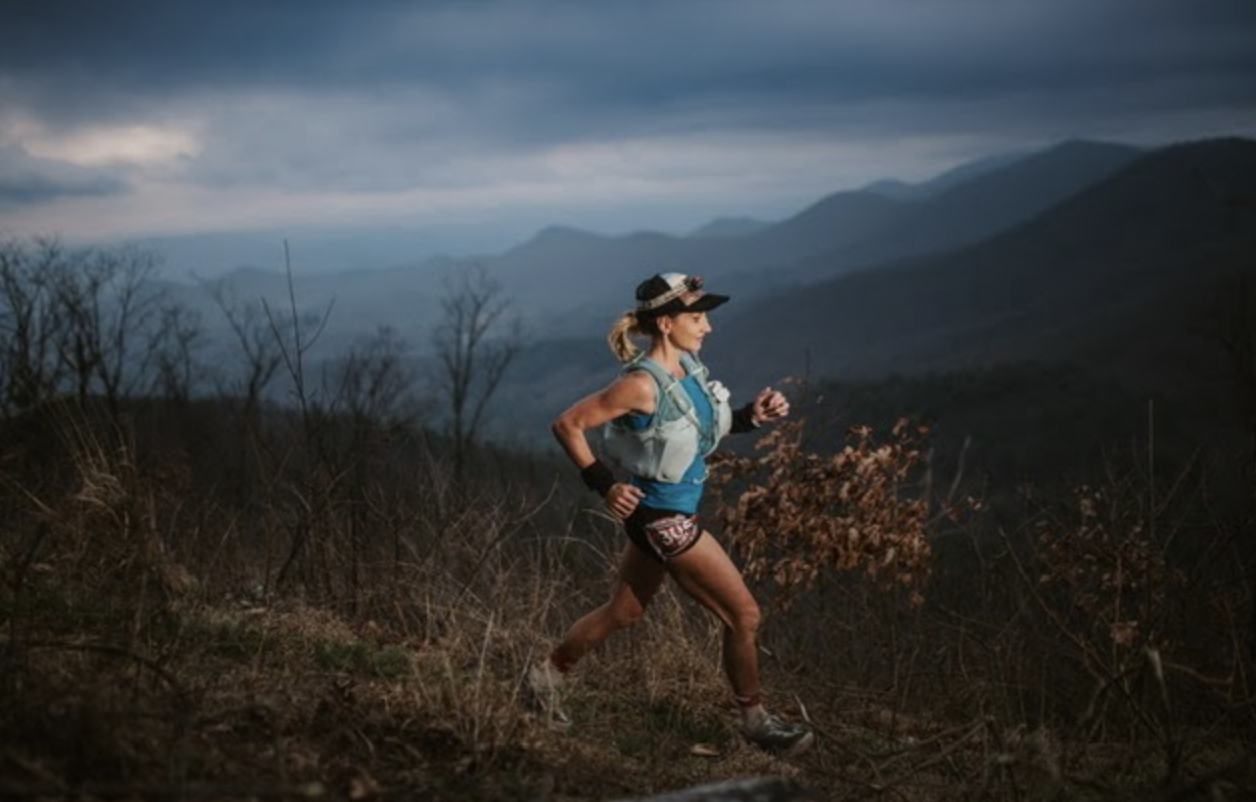
Although those fast times are exciting, my heart really lies in trail running. I’ll take a single-track trail in the mountains over a road run any day. I also had another goal on my mind: running my first 100-miler. I had never attempted it simply because I had never spent a night away from my kids. Once the twins were a little older and I knew they could survive a night without me, I decided to go for it. I chose the 2026 Umstead 100, because it’s local and my kids could go to sleep that night in their own beds. I assumed I would actually need to “train” for a 100-miler, but, once again, I really didn’t change much. I never did any night running, and I was already doing about the maximum amount of running I could fit in while still being present in my more important roles.
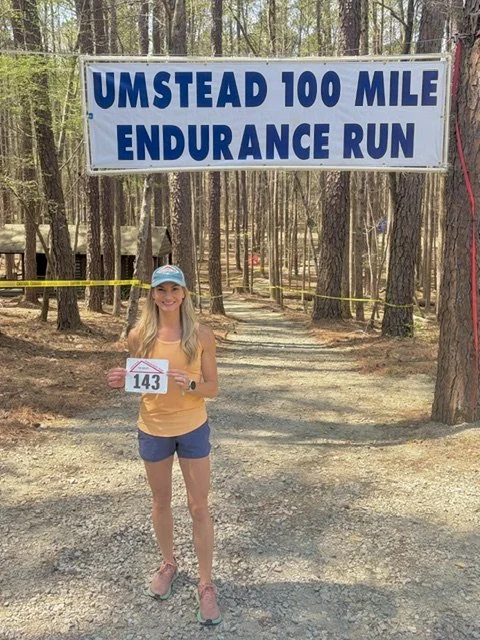
Once again, the race went far better than I could have imagined. My goal was simply to finish feeling good, hopefully in under 24 hours. I finished in 17:41 and placed third female. There were some very strong competitors in the race—the first-place woman was a pro runner —so I was pretty thrilled with how it all turned out, especially knowing that 11 months earlier, I was on crutches. In preparing, I didn’t up the volume much but between gym work and runs, I ran often on tired legs and I think that was key!
Balancing Running, Work, and Kids
I never feel like there is enough time in the day to accomplish everything I hope to, so I wouldn’t say it’s easy. But there are a few things that I think have helped.
The twins’ daycare is not far from my house, so when time and weather allow, we either run or bike to daycare. On weekdays, I use my lunch hour to lift weights. I’m fortunate to work on a university campus where the gym is just a five-minute walk from my office. On days when I work from home, I’ll squeeze in a home workout or make a quick stop at the YMCA.
Some days are busy and I don’t get to stick to my plan, but you’ll rarely find me sitting still. If I’m sitting, it’s probably because I’m in a meeting or I have a kid on my lap. Being this busy though means I have to squeeze in whatever I can, whenever I can. Sometimes workouts are broken into tiny chunks throughout the day, and that’s okay. A typical day might look like running or biking with the kids to school, working, doing a mini lifting session at lunch, working some more, doing calf raises while washing dishes, squats while picking up toys, box jumps on the playground equipment while the kids play, and chasing them around the neighborhood on their bikes or scooters. I’ve become the master of the two-minute power shower—and of being okay with being sweaty all day!
I also have a supportive husband. He works full time and commutes about 3 hrs/day. He’s active duty military so he also travels, which means quite often it’s just me and the kids. But he is a runner and understands that we both parent better when we’ve gotten our daily run or workout in. We do not have family nearby for help, but we take turns parenting so that we can each get long runs in on weekends and support each other's racing habits.
Advice for Injured Runners
Injury can be just as hard mentally and emotionally as it is physically. Remember that it is temporary. The human body is amazing and it will heal itself. You can help it by getting the proper rest and nutrition.
I had to remind myself of that every day…”my job now is to eat well and sleep well” It also helped me to reframe the injury as a gift of time—a chance to focus on other things, particularly spending time with my family. We went on some of our first non-running-related vacations while I was injured. Once I was off crutches but still building back, we did a lot more hiking, kayaking, and biking as a family.
Be patient. Strength comes back. It’s imperative to focus on rebuilding your baseline strength before worrying about running again.
When I first started running after the injury, it didn’t feel right. I could run, but I felt “off.” As much as I wanted it to feel effortless and smooth, it was almost like I had to consciously think about getting my legs to move me forward.
Looking back, I think a lot of that came down to the strength I had lost on my left side. My left leg was significantly weaker than my right, and it was struggling to keep up.
It took a lot of single-leg exercises to finally restore that balance. I started with body weight only, progressed to resistance bands and light weight before getting back to where I was pre-injury. Eventually, the running became smooth again too!
The Best Part
The best part of it all is hopefully setting a good example for these girls. We will never "push" them to be runners but they already seem to love the things we do!
Thank you again for allowing me to share this! Injury is tough and I hope that it helps or inspires at least one person going through something similar.