This is one of the core questions my patients have, whether they explicitly ask it or not.
First, most want to know the why and the how.
Then comes the when.
Then there’s the most important part of my job, figuring out the what. Because everyone is uniquely different and finding what specifically works for that individual is the difference between a full and quick recovery and a nagging unresolved one.
But I digress…
The first questions are usually easy for me. Within 3 sessions, I’ll be pretty confident of the why and the how.
It’s the second question, when, that is more difficult.
When will I get better?
It’s a loaded question.
On the surface level you can just look at the physiological time frame of healing. This is well studied and useful. Depending on the adaptation you need to get better, the chart below gives a good ballpark of how long it will take.
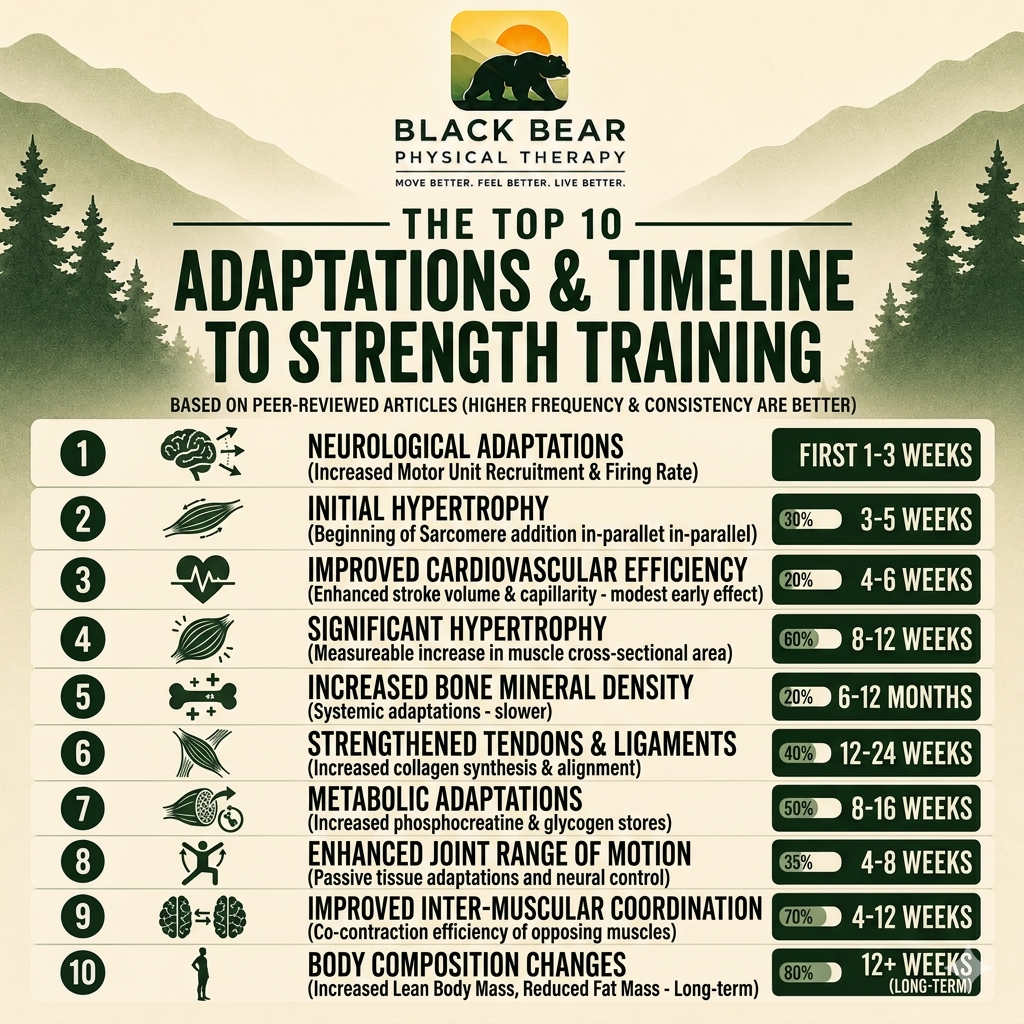
This chart can also be useful to set expectations and manage all the “sales” from influencers on our algorithms. If someone is selling resolving pain immediately with one technique or treatment, then that’s a neurological adaptation and it should happen quickly. You shouldn’t be 3 sessions in with no results if that’s the goal.
On the other hand, if the goal is to reduce pain through fixing a weak link in strength, that could take 8-12 weeks. So expecting a fix 3 session in for that case would be a big mistake.
That’s a long winded way to say the chart above can help guide you towards what treatments you should be chasing and which ones are likely not useful.
As a PT, I am constantly working on multiple of these outcomes at once. I’ll have the program to allow for the long term adaptations in play, while manipulating the nervous system in real time to improve someone’s ability to recover.
The key is getting the patients to understand this process as well…which I’m hoping this post will do.
So really, when will i get better?
Unfortunately there’s a ton of variables that can influence this.
Someone’s overall health will greatly affect the outcomes. You can’t plant a good seed in a bad soil and expect it to grow quickly.
Lifestyle factors like diet, sleep, stress, postures, movement, metabolic health, comorbidities, innate constitution, and mindset all play a huge role.
An important disclaimer, is that you don’t have to be perfect with these and become and health span guru to get better. Just doing a little bit better in one or two of these categories can make a huge difference.
How long can the author dodge this question?
The other factor is the mechanical side of injuries and pain.
If there’s an egregious mechanical factor and the patient can’t alter their mechanical lifestyle, then getting better will take a lot longer.
For example, someone with a cervical radiulopathy and pain down their arm that is exacerbated with cervical protraction and flexion will need to avoid those postures while the tissues recover and the nervous system re-sensitizes. If they keep spending all their time on their phone and sitting down for 8 hours straight while sleeping with 3 pillows, then no exercise or manual therapy will change that.
Or someone with a shoulder impingement that gets irritated with overhead motions doesn’t modify their tennis practice or serving despite the increase in pain.
There are millions of examples. And sometimes stopping the exacerbating mechanics is more important than anything else.
so the answer to when will i get better is…
It depends.
If the patient is motivated, open-minded, able to adjust lifestyle and mechanical factors, and seek proper treatment, then the chart above should be very accurate.
If those variables are more difficult to manage, the answer will be much less clear.
And this isn’t to judge either. I’ve been in both situations at different points in my life. Both situations can get better. There’s always room to improve.
So whether you’re ready to make big changes and alter your life, or you just want to try to get out of pain with some help, we’re here for you.
Give us a call or drop a comment if you have any questions.