A new clinical trial suggests that treating obesity can dramatically reduce knee pain—and adds to decades of research suggesting that osteoarthritis is more complicated than simple joint degeneration.
For decades, osteoarthritis has been explained as a mechanical problem.
The cartilage in your knee gradually wears down. The joint becomes damaged. Eventually, you develop pain.
But research increasingly suggests this explanation is incomplete.
A new study published in the New England Journal of Medicine provides another compelling reason to reconsider how we think about knee osteoarthritis, obesity, and pain.
And surprisingly, the story goes back more than 30 years.
The New Study: Significant Reductions in Knee Pain
In 2026, researchers published results from a large randomized controlled trial investigating retatrutide, an experimental medication designed to treat obesity.
Retatrutide acts on three hormone receptors involved in metabolism and appetite: GLP-1, GIP, and glucagon.
The study included:
2,339 adults with obesity but without diabetes.
574 participants who also had knee osteoarthritis.
80 weeks of treatment with either retatrutide or placebo.
Researchers measured changes in body weight and knee pain using the WOMAC pain scale, a commonly used measure of osteoarthritis symptoms.
The results were impressive.
Participants receiving higher doses of retatrutide lost approximately 24–25% of their body weight, compared with 3.9% in the placebo group.
More importantly for our discussion, people with knee osteoarthritis experienced substantially greater pain relief.
What happened to knee pain?
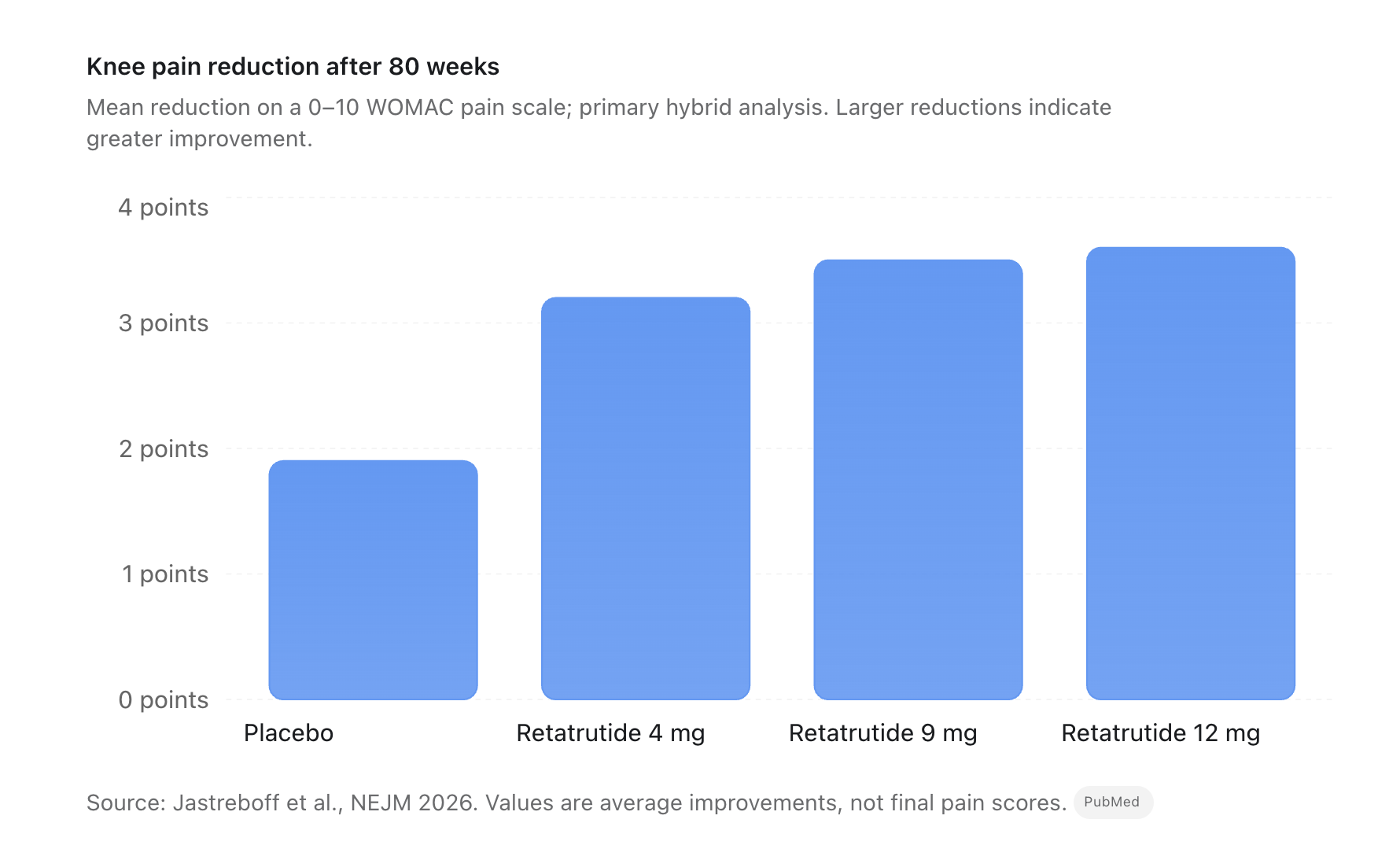
The WOMAC pain scale in this study ranged from 0 to 10, with higher scores indicating more pain.
TreatmentAverage reduction in knee painPlacebo1.9 pointsRetatrutide 4 mg3.2 pointsRetatrutide 9 mg3.5 pointsRetatrutide 12 mg3.6 points
These are the study's primary analysis estimates.
At the two higher doses, participants experienced approximately 1.6–1.8 additional points of pain reduction compared with placebo, a statistically significant difference.
This is important: people receiving placebo also improved. The meaningful comparison is the additional improvement associated with the medication, not simply the total improvement in the treatment group.
The trial was funded by Eli Lilly, the manufacturer of retatrutide. The medication remains investigational as of November 2026.
The Bigger Question: Why Did Their Knees Hurt Less?
The obvious explanation is that losing weight reduces mechanical stress on the knees.
And that's certainly a reasonable explanation.
Your knees experience substantial forces during activities like walking, running, climbing stairs, and standing up from a chair.
Reducing body weight can decrease those forces.
But there's another possibility worth considering.
What if some of the pain associated with osteoarthritis is influenced by metabolic processes throughout the body—not just mechanical stress on the joint?
Fat tissue isn't simply passive weight. It is biologically active, producing hormones and inflammatory signaling molecules that can influence tissues throughout the body.
Metabolic dysfunction may also contribute to changes in inflammatory activity, joint tissues, and pain processing.
That raises an interesting possibility: improving metabolic health might influence knee pain through several pathways simultaneously.
However, this particular study cannot tell us how much of the pain improvement came from reduced joint loading, improved metabolic function, changes in inflammation, or other effects of the medication.
The study demonstrates meaningful pain relief. It does not establish the precise mechanism.
This Idea Actually Goes Back to 1995: The Chingford Study
More than 30 years ago, researchers studying 1,003 middle-aged women in England began examining whether osteoarthritis was associated with factors beyond age, injury, and body weight.
The research became known as the Chingford Study.
In a 1995 publication, researchers investigated the relationship between knee osteoarthritis and several metabolic health markers, including blood glucose, cholesterol, and blood pressure.
They found some fascinating associations.
Compared with women with lower values, women with elevated blood glucose had approximately:
1.95 times the odds of radiographic knee osteoarthritis.
2.77 times the odds of symptomatic knee osteoarthritis.
Elevated cholesterol was also associated with radiographic osteoarthritis, while a history of hypertension was associated with bilateral knee osteoarthritis.
Perhaps most interestingly, several of these associations persisted even after accounting for age and body mass index.
This suggested that factors related to metabolic health might contribute to osteoarthritis beyond the simple mechanical consequences of excess body weight.
Read the original 1995 Chingford Study
Osteoarthritis Is a Whole-Joint Condition, Not Just Cartilage Loss
One of the biggest misconceptions about osteoarthritis is that cartilage damage directly determines pain. Or that it’s purely mechanical.
It isn’t.
Cartilage itself has very little capacity to generate pain because it lacks sensory nerves.
Pain can arise from other structures, including the synovium, subchondral bone, joint capsule, ligaments, and surrounding tissues.
Additionally, the nervous system influences how strongly these signals are experienced.
This helps explain why two people with similar X-rays may have very different levels of pain.
One person may have significant radiographic arthritis and remain remarkably active.
Another may experience substantial pain despite relatively modest changes on imaging.
The amount of structural degeneration and the amount of pain are related, but they are not the same thing.
Pain is influenced by many interacting factors, including mechanical loading, inflammation, sleep, physical capacity, metabolic health, previous experiences, and nervous system sensitivity.
This doesn't mean the structural condition of the knee is irrelevant.
It means structure is only one part of the story.
What Does This Mean for Treating Knee Osteoarthritis?
The exciting part of this research isn't necessarily that everyone with knee osteoarthritis should start taking weight-loss medication.
It's that we have more reasons to think broadly about the condition.
For people managing knee osteoarthritis, several strategies deserve consideration.
1. Strength training
Improving the capacity of the quadriceps, hips, calves, and surrounding musculature helps people tolerate the demands placed on their knees.
Strength training is one of the most important evidence-supported interventions for knee osteoarthritis.
2. Aerobic exercise
Walking, cycling, swimming, and other forms of aerobic exercise can improve function, cardiovascular health, and symptoms.
The presence of osteoarthritis does not mean your knees should stop moving.
3. Weight management, when appropriate
For people with overweight or obesity, weight loss can meaningfully reduce knee pain and improve function.
The 2026 retatrutide study provides additional evidence of the potential magnitude of symptom improvement.
4. Metabolic health
Blood glucose regulation, cardiovascular health, blood pressure, and other metabolic factors deserve attention for overall health—and may have relevance to joint health.
However, we still need more research to determine whether improving these factors independently reduces osteoarthritis pain.
5. Individualized pain management
Treatment should consider the person, not just the X-ray.
Activity tolerance, strength, sleep, lifestyle, pain sensitivity, and personal goals all influence the treatment plan.
The Most Important Takeaway
For years, osteoarthritis was commonly described as the inevitable consequence of joints wearing out.
But the evidence tells us a much more interesting story.
In 1995, the Chingford Study raised questions about the relationship between metabolic health and osteoarthritis.
In 2024, a randomized trial found that semaglutide produced meaningful reductions in knee osteoarthritis pain alongside weight loss.
And now, in 2026, a large clinical trial has demonstrated substantial improvements in knee pain among people receiving retatrutide.
We still don't know exactly how much of these benefits comes from reduced mechanical loading versus other biological effects.
But we do know something important:
Knee osteoarthritis is not simply a worn-out joint, and pain is not an inevitable measurement of cartilage damage.
Mechanical stress matters. Body weight matters. Metabolism may matter. The nervous system matters.
And perhaps most importantly, there are multiple ways to improve pain and function.
At Black Bear Physical Therapy, this is the perspective we bring to rehabilitation: understanding the entire person rather than treating an imaging finding.
Find the Cause. Build the Plan.
Research References
Jastreboff AM, et al. (2026). Retatrutide, a Triple Hormone Receptor Agonist, for Treatment of Obesity. New England Journal of Medicine. Read study
Hart DJ, Doyle DV, Spector TD. (1995). Association between metabolic factors and knee osteoarthritis in women: The Chingford Study. Journal of Rheumatology. Read study
Sanchez-Santos MT, et al. (2019). Association of metabolic syndrome with knee and hand osteoarthritis: A community-based study of women. Seminars in Arthritis and Rheumatism. Read study
Bliddal H, et al. (2024). Once-Weekly Semaglutide in Persons with Obesity and Knee Osteoarthritis. New England Journal of Medicine. Read study